

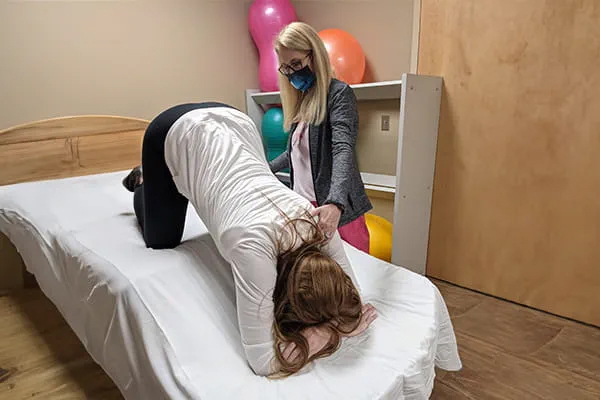
The UAB St. Vincent’s Labor and Delivery nurses go through extra training to help moms and their babies prepare for the best possible birthing experience. This training includes the Spinning Babies® program, which offers a different way of looking at pregnancy, labor, and birth preparation.
Rather than focusing solely on the medical aspects of childbirth, it encourages mothers to understand and support their body’s natural processes throughout pregnancy and labor.
“By offering the Spinning Babies program to our families, we are helping shift the perspective on birth from one that is primarily medically driven to one that embraces the body’s natural physiological process,” said Nicole Carlisle, BSN, RNC-OB. “When mothers learn how to work with their bodies rather than against them, they gain confidence, knowledge, and a greater sense of empowerment throughout their birth journey. We often see mothers go from saying, ‘I don‘t know if I can do this’ to confidently believing, ‘I was made for this – my body was designed to do this.’”
Positioning is key
Spinning Babies is a training program that teaches nurses techniques that can use to instruct expecting parents to help support a baby’s delivery, with a focus on body movements and fetal rotation. Over the decades, studies have shown that the position of the baby in the pelvis – along with the mother’s physical birthing position – typically results in smoother labor and delivery.
UAB St. Vincent’s Labor and Delivery nurse Kenna Praytor, RN, has seen firsthand how the program has become a valuable part of care in the Birth Suites. She serves as a resource nurse, helping coordinate care for laboring women on the unit and providing an extra set of hands during delivery.
“All of the resource nurses on our unit have been trained in many courses concerning care of laboring and birthing women and their babies, including the Spinning Babies Workshop,” Praytor said. “By using our years of experience and the knowledge and techniques learned from Spinning Babies, we are able to assist in encouraging the progression of labor while also decreasing the need for unnecessary interventions.”
Praytor says simple movements can be effective in helping babies turn to face the correct direction, such as the mom moving to her hands and knees.
“By using these positions regularly, we have been able to significantly decrease pushing times and also help decrease C-section rates for moms who choose to be induced,” Praytor said. “The UAB St. Vincent’s Birth Suites are always striving to give our patients a safe, comfortable environment, and we help them achieve the birthing experience they desire whenever possible.”
Making an impact
Labor and Delivery nurse Kelsey Trusty, BSN, RN, has spent 10 years caring for mothers and babies at UAB St. Vincent’s. During that time, she has seen the impact that Spinning Babies can have on labor progress and birth outcomes.
“One of the most rewarding parts of my work is witnessing the incredible changes that can happen when a mother‘s body and her baby are given the support they need,” Trusty said. “I’ve seen Spinning Babies help babies rotate into more optimal positions for birth, leading to smoother labors and less pushing time for moms. I’ve also seen breech babies turn head-down, giving families the opportunity to pursue the vaginal birth they were hoping for.”
For Trusty, what makes Spinning Babies unique is the way it helps caregivers and families better understand what is happening during labor.
“Rather than simply observing the process, it helps us better understand how a baby’s position can influence a mother’s experience, labor progress, and birth outcomes,” Trusty said. “For me, Spinning Babies is more than a set of techniques; it’s a way of understanding birth that helps families feel supported, educated, and connected to the amazing work their bodies and babies are doing.”
Learning by experience
Carlisle’s appreciation for Spinning Babies extends beyond her professional role. During her second pregnancy, she decided to put the techniques she had been teaching into practice herself.
“When I became pregnant with my second baby, I had already attended multiple Spinning Babies trainings and found myself asking, ‘If I‘m going to teach this to other moms, shouldn’t I practice what I preach?’” Carlisle said.
Beginning at 24 weeks, she committed to incorporating daily Spinning Babies techniques and body balancing exercises into her routine.
“The difference was remarkable,” Carlisle said. “Compared to my first pregnancy, my body felt more balanced, comfortable, and capable. I experienced fewer aches and pains, slept better, gained less weight, and enjoyed a healthier pregnancy overall.”
Carlisle says the benefits continued during labor, when an understanding of positioning and movement helped her feel more confident and engaged in the birthing process.
“Instead of feeling like labor was happening to me, I felt like I was working with my body every step of the way,” Carlisle said. “That experience transformed me from someone who appreciated Spinning Babies professionally into someone who truly believed in it personally.”
Not unlike yoga
Similar to yoga in some ways, Spinning Babies is all about helping the body achieve great things through slow and simple movements. Another thing they have in common are some unique and memorable position names. Birth Suites nurses regularly use techniques called side-lying release, shake the apple tree, and flying cowgirl to help create space and encourage optimal fetal positioning throughout labor.
According to Trusty, one of the greatest benefits of the program is the way it strengthens teamwork among nurses while actively involving families in the birth experience.
“Nurses work side by side to help mothers find positions that support labor progress, and we often invite partners to be part of the process, too,” Trusty said. “It’s not uncommon to hear us say, ‘Come on over, Dad – let me show you how you can help with this position change.’ Those moments transform partners from observers into active participants in the birth experience.”
A unique aspect of Spinning Babies is that the movements are not reserved for those who choose an unmedicated birth. Patients who receive an epidural also can benefit from positioning techniques and guided movement throughout labor.
“One of the most rewarding things is working with a mom who may be feeling exhausted or unsure if she’s making progress and then watching her see the difference these techniques can make,” Trusty said.
Helping a mother welcome her baby into the world is a beautiful experience, Trusty said, adding that a calm, supportive environment allows caregivers to better deliver whole-body, family-centered care.
Spinning Babies is used by the Labor and Delivery team during the birth experience. But pregnant women also can learn the techniques through the UAB St. Vincent’s Maternity Support Center (previously known as Monogram Maternity).
Register for a Spinning Babies class, or call 205-212-MOMS (6667) to learn more.