

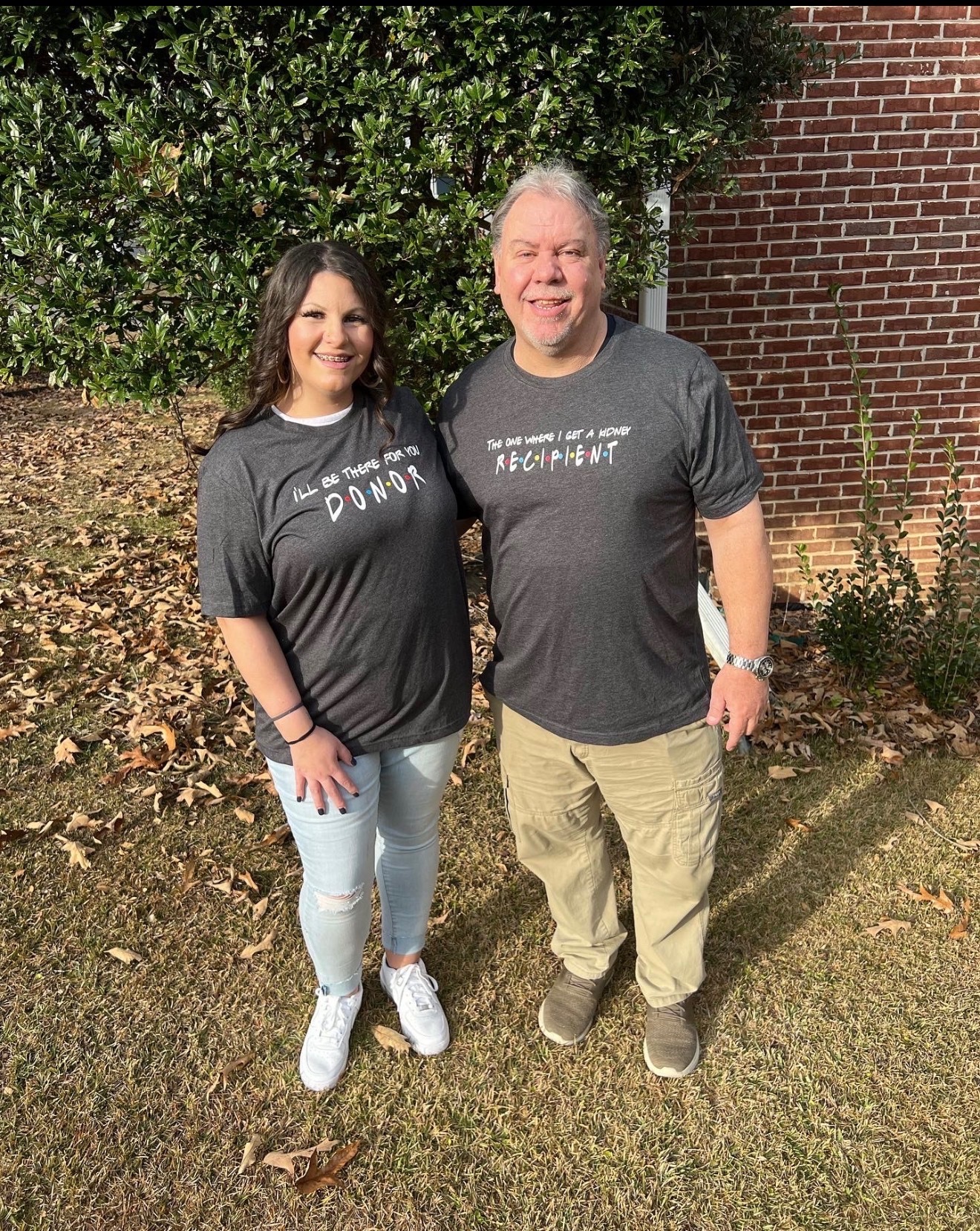
Parents will do anything for their children. But when one father’s health began to fail, his daughter gave him the most meaningful gift of all: life.
Chris Cater admits that he should’ve taken better care of himself over the years.
“It probably started back in my mid-20s,” Chris said. “I went to Samford University and played football, but after graduating, I just didn’t take care of myself and gained some weight.”
Those extra pounds – combined with high blood pressure and years of using over-the-counter pain relievers – took a toll on his kidneys. Also, he was diagnosed with kidney cancer and had his left kidney removed, which stressed his other kidney even more.
When his remaining kidney started failing, he was placed on the transplant list. That was the beginning of what could be a very long wait.
Finding a match
Kidneys can come from living or deceased donors, and both types of transplants come with their own hurdles. According to the National Kidney Foundation, the average wait time for a deceased donor kidney is 3-5 years. But it could be longer depending on the patient’s blood type and other medical factors.
On the other hand, receiving a kidney from a living donor can greatly reduce the wait. But finding a match isn’t always easy. Chris’ family spread the word, and many of their friends and relatives registered as living donors.
They struggled to find a match at first, but when Chris’ daughter, Caitlin, went to the UAB Kidney and Pancreas Transplant Clinic to get tested, she had a strong feeling that she’d be the one. Her blood type was O Positive – the same as her father – and additional tests confirmed that she was indeed a match.
In the end, Caitlin says being a living donor for her father was an easy decision.
“My dad and I have always been super close, so I was overjoyed when I found out,” she said. “This was something I wanted to do. I knew that if he did not have a living donor, he would probably still be on the transplant list, because there are so many people who need them.”
Challenges ahead
However, the road to a transplant would not be an easy one. After determining that Caitlin was a match in July 2022, doctors told her that her body mass index (BMI) was too high and that she’d have to lose 45 pounds before the surgery.
“I had to do it naturally – no GLP-1s or anything like that – so I got on a strict diet and started working out five days a week,” Caitlin said, adding that her best friend, Sarah, helped motivate her to stay on track. “She really picked me up and reminded me what I was doing it for on days when I did not want to put forth the effort.”
Caitlin achieved her weight loss goal within a few months, but some additional tests were still needed before the transplant could be approved.
“The last couple of months were the hardest – when you’re so close and just waiting to get that date,” Chris said.
In December 2022, they finally got the call saying they were approved. But before going into surgery, Caitlin had to promise her surgeon – Michael Hanaway, M.D., surgical director of the Kidney Transplant Program at the UAB Comprehensive Transplant Institute – that she’d stay healthy after the transplant.
A second chance
On Jan. 25, 2023, Chris and Caitlin went in for the surgery.
“I didn’t have any pain whatsoever,” Chris said. “I stayed seven days to make sure everything was working, but I think once they attached Caitlin’s kidney, it started functioning immediately.”
Chris had some heart problems in the past, and like any major surgery, the transplant put some stress on his heart. But this was treatable, and he worked with Vineeta Kumar, M.D., and Shikha Mehta, M.D., with the UAB Division of Nephrology during his recovery.
“Everything I had after the surgery was heart-related, and Dr. Kumar and Dr. Mehta really just took hold of my case and made sure I was ok,” Chris said. “I’ve not had one problem in three years. My back pain went away, my blood pressure is good, and I’ve lost a lot of weight – it’s the lowest I’ve been since college – so it has just worked amazingly.”
Caitlin stayed in the hospital for two days and felt like her old self after two weeks, apart from some soreness. “I still live just like I had two kidneys,” she said. “I may have to urinate a little more, but other than that I’m fine.”
“It’s amazing what they can do at UAB,” Chris said. “They saved my life and definitely saved me from going on dialysis.”
“Dr. Hanaway and all of our doctors were phenomenal,” Caitlin added. “We’re forever indebted to everyone at UAB.”
Giving back
Just shy of a year after the surgery, Caitlin found out that she would be giving her father another gift: his first grandchild. Her pregnancy would be considered high-risk, since she only had one kidney. Due to high blood pressure, she gave birth via cesarean section a few weeks before her due date.
“Dad was actually at the kidney clinic, having his checkup, and he had to leave to come get me and take me to hospital to have my baby,” Caitlin said. “Now he’s almost two years old, and he is the spunkiest little thing – all boy, never slows down.”
“The year before the surgery, I couldn’t do a whole lot,” Chris recalls. “But now I have more energy and I’m able to golf again, umpire high school baseball, and play with my grandson.”
Today, Chris urges young athletes to take better care of themselves and encourages those waiting for their own transplant to stay positive. His family volunteers with Legacy of Hope – Alabama’s federally designated, nonprofit organ procurement organization – and participates in National Donate Life Month each April to raise awareness about organ donation.
“Our mission is to get more living donors and let them know that you can live a normal life just like you would with two kidneys,” Caitlin said. “It doesn’t hurt to get tested. You can save somebody’s life and give that family another day with their loved one.”
Please visit the UAB Medicine Living Kidney Donor Program for information on becoming an organ donor.