

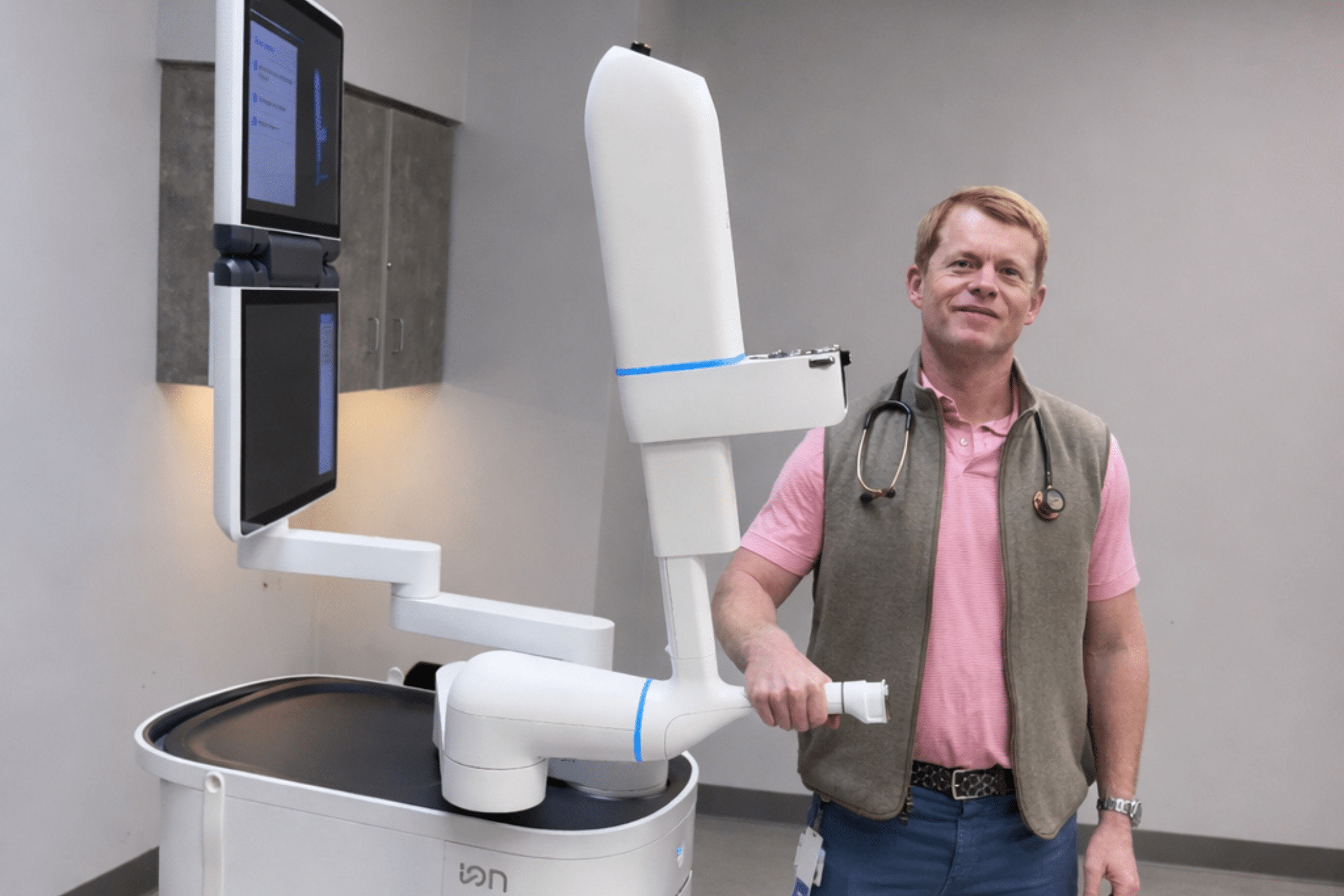
UAB St. Vincent’s East introduced new robotic technology designed to aid in the early detection of lung cancer, a leading cause of cancer-related deaths in the United States.
Brian Flanagan, M.D., a pulmonologist at UAB St. Vincent’s East, recently performed the hospital’s first bronchoscopy procedure (lung exam) using this advanced system.
The robotic technology is being used by a multi-specialty team at UAB St. Vincent’s East that includes pulmonologists, thoracic surgeons, and cardiothoracic surgeons, to biopsy small lung nodules that were previously difficult or impossible to access with traditional methods.
The ability to easily reach these nodules allows physicians to make earlier and more accurate diagnoses. This can greatly improve outcomes by finding cancer at its earliest stages, when it’s most treatable.
“The great thing about this procedure is that it allows us to biopsy very small nodules,” said Flanagan. “This is a minimally invasive procedure and is very low risk to the patient,” Dr. Flanagan said. “Making a diagnosis with a biopsy at a very early stage can make a significant difference in outcomes for patients facing a lung cancer diagnosis.”
Lung cancer is the leading cause of cancer death, largely due to late diagnosis and the absence of symptoms in the early stages. Historically, patients with lung nodules detected during imaging scans often had limited diagnostic options. Traditional biopsy procedures could be invasive and risky, leading many providers to recommend follow-up imaging months later to monitor nodules. This approach could delay diagnosis and treatment.
The addition of robotic bronchoscopy technology at UAB St. Vincent’s East represents a significant advancement in lung cancer care, offering patients a safer, less invasive diagnostic option.